
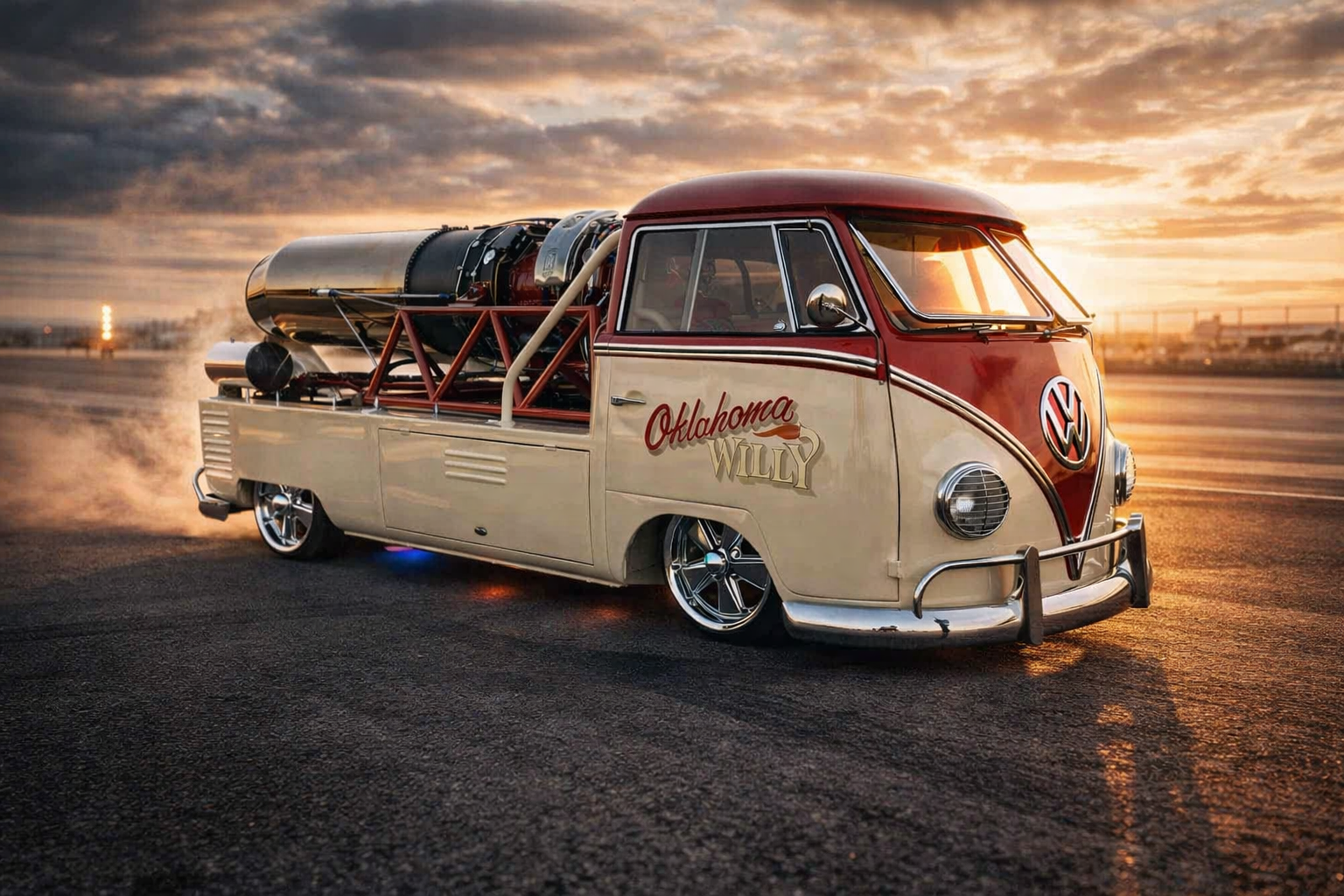
Every so often a vehicle appears in the Volkswagen world that reminds everyone just how creative – and sometimes outrageous – automotive culture can be. Oklahoma Willy is one of those machines. What began life as a humble Volkswagen Type 2 pickup has evolved into one of the most unusual and memorable vehicles ever associated with the VW scene: a fully operational jet-powered drag racing bus.
At first glance, Oklahoma Willy still carries the unmistakable silhouette of a classic split-screen Volkswagen. The rounded nose, upright windscreen, and familiar body lines all remain. But look a little closer and the illusion quickly fades. Mounted in the back is a massive aircraft turbine engine capable of producing thousands of pounds of thrust. Instead of quietly carrying tools or supplies like it would have done in the late 1950s, this particular VW now launches down drag strips at extraordinary speeds.
The story behind Oklahoma Willy isn’t just about raw speed or spectacle. It’s a fascinating example of the creativity that has always existed within Volkswagen culture. Builders have always experimented with these vehicles – lowering them, racing them, turning them into campers or off-road machines. But turning a classic Transporter into a jet-powered drag vehicle pushes that experimentation to an entirely different level.
Oklahoma Willy was created by American builder and drag racing enthusiast Ron Patrick, a man known for building some of the most unusual jet-powered vehicles ever seen at motorsport events.
Patrick had long been fascinated by turbine engines and the dramatic performance they could produce when mounted in ground vehicles. Instead of choosing a conventional car chassis, he wanted something that would surprise people – something instantly recognisable that nobody would expect to see at the drag strip.
His choice was a 1958 Volkswagen Type 2 pickup truck.
The Transporter platform was never designed for high-speed racing. In its original form, a late-1950s VW bus produced modest horsepower and was intended for utility work rather than performance driving. That contrast was exactly what made the idea appealing. Patrick saw the potential to transform something simple and familiar into something extraordinary.
The build required major structural changes. The original drivetrain was removed and the chassis reinforced to cope with the extreme forces created by a jet engine. A custom frame structure was fabricated behind the cab to support the turbine while still allowing the vehicle to retain its recognisable Volkswagen appearance.
Over time the project evolved into what is now known worldwide as Oklahoma Willy.
The true centrepiece of Oklahoma Willy is the massive turbine engine mounted behind the cab. The engine used in the vehicle is a General Electric J85 turbojet, an aircraft engine most famously used in military aircraft such as the Northrop F-5 fighter jet.
Originally designed for aviation use, the J85 is capable of producing around 5,000 pounds of thrust. In aircraft applications this thrust helps propel fighter jets through the air at high speed. When mounted in a ground vehicle like Oklahoma Willy, the same force pushes the vehicle forward with incredible acceleration.
Unlike a conventional engine that sends power through a gearbox to the wheels, a turbojet produces thrust by compressing air, mixing it with fuel, and igniting it to produce extremely hot exhaust gases. These gases are expelled from the rear of the engine at very high velocity, generating forward motion.
The effect is closer to rocket propulsion than traditional automotive engineering.
When the engine starts, it spools up with the unmistakable high-pitched whine associated with aircraft turbines. As throttle is applied, the sound intensifies into a deep roaring blast that can be heard across the entire drag strip.
Installing a jet engine into a vintage Volkswagen is far more complicated than simply bolting the engine to the back of the vehicle. The engineering challenges involved are substantial.
First, the chassis had to be strengthened to handle the thrust loads generated during acceleration. Reinforcement structures were added to distribute the forces throughout the frame and prevent structural failure. The engine itself sits in a custom mounting system that allows it to remain stable during high-speed runs.
The vehicle also required a specialised fuel system capable of supplying aviation fuel to the turbine. Jet engines consume fuel at a far greater rate than traditional automotive engines, so larger fuel tanks and dedicated fuel pumps are required.
Heat management is another major concern. The exhaust gases produced by the J85 engine reach extremely high temperatures, which means the surrounding components must be carefully shielded and positioned to avoid damage.
Braking systems were also upgraded significantly. When a vehicle accelerates as quickly as Oklahoma Willy does, stopping it safely becomes just as important as making it go fast.
Despite these challenges, the finished machine remains surprisingly faithful to the look of the original Volkswagen pickup, which is part of what makes the vehicle so visually striking.
Driving Oklahoma Willy is unlike operating any conventional vehicle. Instead of responding to engine revs and gear changes, the vehicle behaves more like a jet aircraft accelerating along a runway.
When the turbine begins to spool up, there is a brief moment where the engine gathers speed internally. Then the thrust builds rapidly and the vehicle begins to surge forward.
Because the propulsion system relies on thrust rather than wheel torque, acceleration feels smooth yet incredibly powerful. The force pushing the vehicle forward increases steadily as the turbine reaches full output.
Drivers must remain extremely aware of their surroundings. The exhaust blast behind the engine is powerful enough to move debris and create intense heat, which is why the vehicle is only operated in controlled environments such as drag strips or demonstration events.
Oklahoma Willy has appeared at numerous drag racing exhibitions and motorsport events across the United States and internationally. It is often invited as a demonstration vehicle rather than a competitive racer, as the spectacle of a jet-powered VW bus is enough to draw large crowds.
During runs, the vehicle has been known to reach speeds well over 180 mph, covering the quarter mile in roughly eight seconds depending on track conditions.
For spectators, the experience is unforgettable. The sound alone is unlike anything normally heard at a VW event. The combination of a classic split-screen bus and the thunder of a jet turbine creates a moment that perfectly captures the creativity of the wider automotive community.
Official information about the vehicle and its appearances can sometimes be found through Ron Patrick’s website:
Official website:
http://www.oklahomawilly.co.uk/
Drag racing events where vehicles like Oklahoma Willy sometimes appear include:
NHRA events:
https://www.nhra.com
These appearances vary year by year, as demonstration vehicles often travel to different shows and exhibitions.
Part of what makes Oklahoma Willy so fascinating is the contrast between its origins and its current form. The Volkswagen Transporter was originally introduced in 1950 and quickly became one of the most recognisable utility vehicles in the world.
Over the decades the platform has been used for everything from camper conversions to work vans, surf vehicles, and family road trip machines.
Oklahoma Willy represents the extreme edge of that creative spectrum. It shows how a vehicle associated with freedom, travel, and community can also become the foundation for something completely unexpected.
The build may be unusual, but the mindset behind it is very familiar within the VW scene. Enthusiasts have always loved modifying these vehicles, experimenting with ideas, and building something that stands out from the crowd.
In that sense, Oklahoma Willy isn’t just a drag racing curiosity. It’s a celebration of the creativity that has always been part of Volkswagen culture.
Discover more VW culture and campervan lifestyle stories:
https://volkstoff.com