

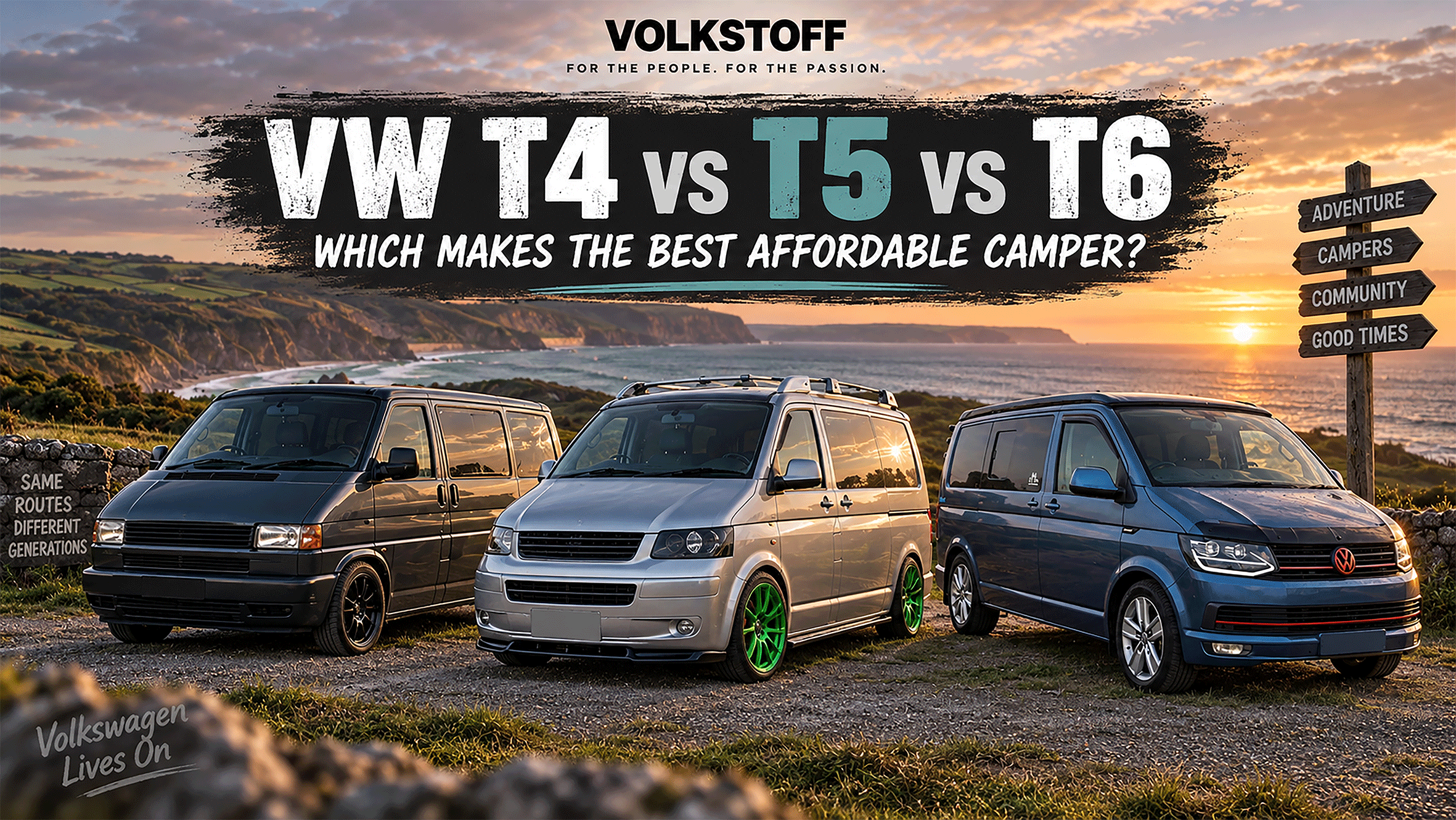
Buying a Volkswagen camper has a habit of starting with the romantic bit.
You picture a Friday afternoon escape, a van parked beside the coast, camping chairs outside and somewhere to sleep without having to book a hotel. For somebody looking at campervan ownership for the first time, an older Transporter can still appear to be one of the most accessible routes into that lifestyle.
Then reality gets involved.
The VW T4 vs T5 vs T6 question is not simply about which generation costs the least to buy. It is about which one you can realistically afford to own, maintain and continue enjoying once the novelty of the purchase has worn off.
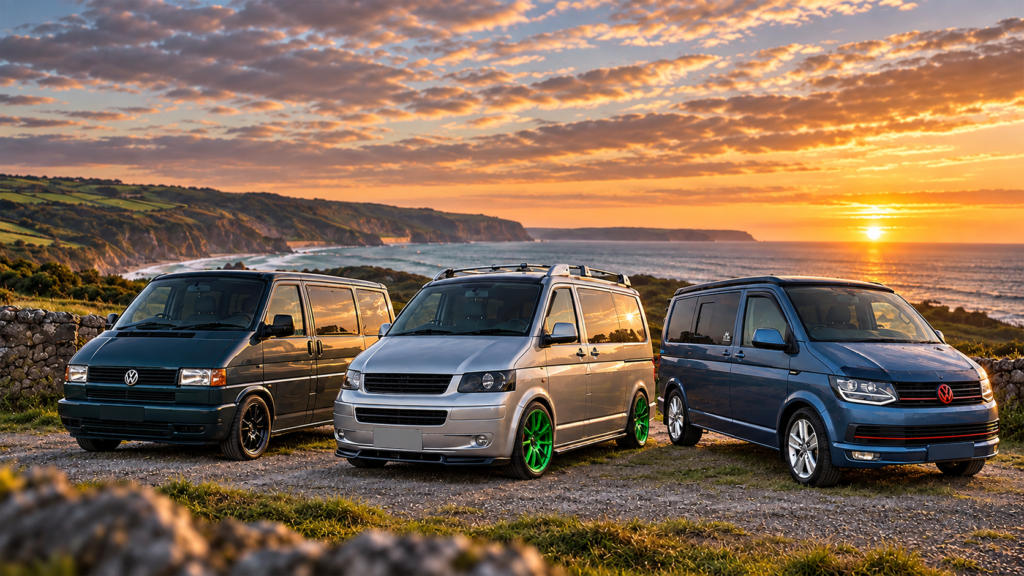
Volkswagen introduced the front-engined, front-wheel-drive T4 in 1990, followed by the T5 in 2003 and the T6 in 2015. The T6.1 arrived in 2019 with a substantially revised dashboard, steering and technology package. Volkswagen Vans
Three generations. Three very different ownership experiences.
And, as we have learned through our own vans and the people we feature through Volkstoff, there is no simple winner.
The real question is: affordable to buy, or affordable to own?
At first glance the maths appears straightforward.
A T4 will generally cost less than a comparable T5. A T5 normally sits below a T6, while a late T6.1 camper can cost several times what an older T4 does.
Current UK asking prices show just how wide the gap between generations has become. T4 campers can still appear from the mid-thousands, while well-presented converted T5 and T5.1 examples commonly move into five figures. T6 and T6.1 campers sit much higher again, with professionally converted later vans often reaching well into £30,000–£60,000 territory.
These are asking prices, not achieved sale values, and conversion quality, mileage, specification and VAT status can move prices dramatically. Treat them as a snapshot of the September 2026 market rather than a fixed price guide.
Market snapshot checked: September 2026. Autotrader
That does not automatically make the cheapest T4 the cheapest camper to own.
An older van can ask for its money differently.
A T4 may want welding and suspension work. A T5 might need specialist diagnosis or an expensive drivetrain repair. A T6 could produce a bill involving emissions equipment, electronics or DSG components.
The financial risk hasn’t disappeared as Volkswagen developed the Transporter.
It has moved.
And that distinction is one of the most important things a first-time camper buyer can understand.
The T4 has crossed an important line.
It is no longer simply an old commercial vehicle.
Built from 1990 until 2003, the T4 was a fundamental change for Volkswagen, introducing a front engine and front-wheel drive to the Transporter and offering two wheelbases. Volkswagen Vans
The youngest examples are now more than two decades old. Early vans are well into classic-car territory.
That creates both opportunity and risk.
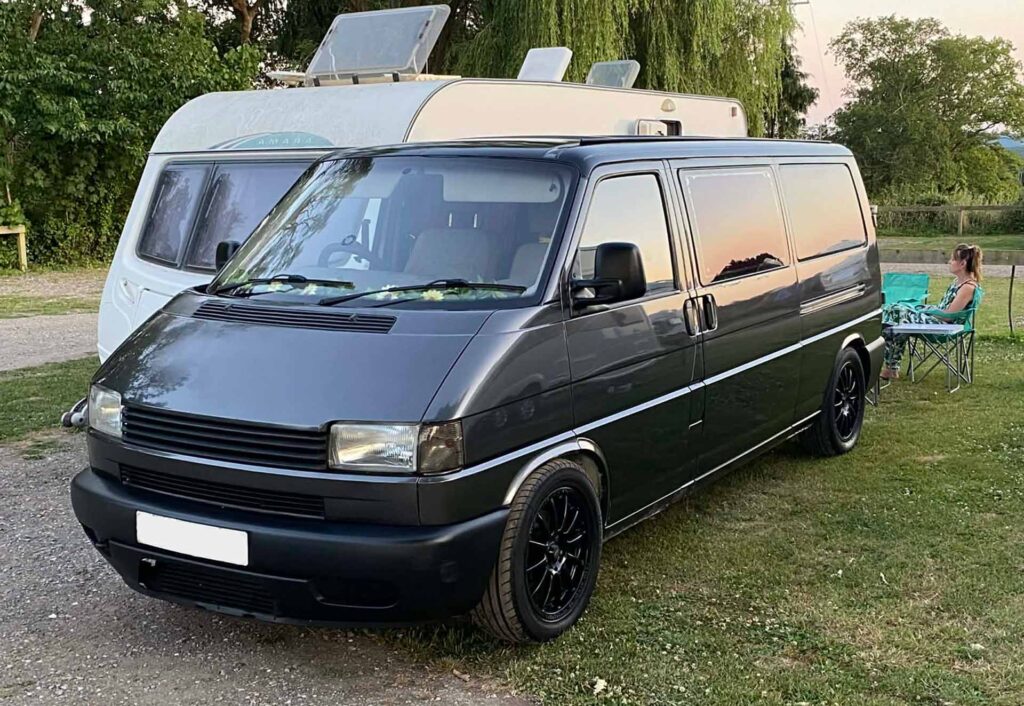
A fundamentally solid T4 still offers one of the most involving routes into VW camper ownership. Compared with later generations, many versions are mechanically understandable. There is enormous enthusiast knowledge around them, good parts support and less dependence on electronic control systems.
That is one reason people like Steve and his T4 are important to this story.
Keeping these vans alive increasingly means owners learning them.
You find out what a suspension bush does because yours needs replacing. You learn about cooling systems because a flange starts leaking. You discover what decent previous welding looks like because somebody has already been underneath your van with a MIG welder.
That education becomes part of ownership.
But it would be irresponsible to translate that into “T4s are simple and cheap to fix.”
They’re old.
Age affects metal, wiring, rubber, hoses, fixings, brakes, suspension, mounts, cooling systems and decades of previous repairs.
Rust deserves particular attention. Sills, arches, jacking areas, seams, the windscreen surround and the actual structure underneath the van should be inspected properly rather than judged by shiny paint.
Fresh underseal should never automatically be interpreted as good news.
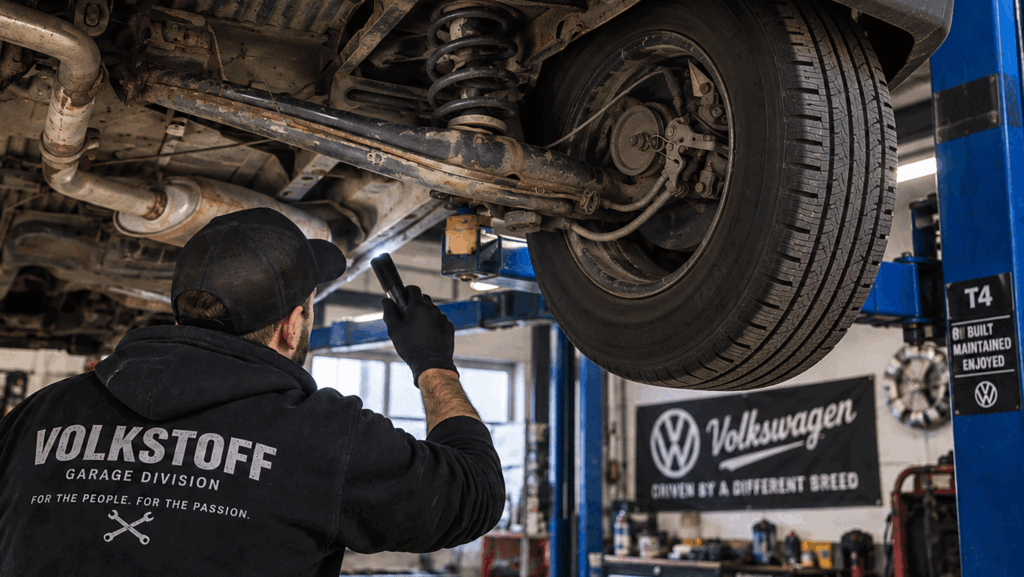
A good T4 therefore asks something of its buyer that a newer van may not:
Are you prepared to become involved?
For the right person that is part of the attraction.
For somebody who has no interest in maintaining an ageing vehicle and will be paying labour rates for every problem, the apparently cheap T4 can become an expensive introduction to camper ownership.
That does not make the T4 a bad choice.
It makes buying the right T4 incredibly important.
Then things get interesting.
The T5 arrived in 2003 and stayed in production until 2015, bringing a more modern driving environment and a huge range of commercial and passenger variants. Volkswagen produced around 1.65 million T5s during its run. Volkswagen Vans
For camper buyers, the T5 occupies perhaps the most interesting position of all three generations.
It still feels sufficiently old-school that many enthusiasts work on them themselves.
Yet it is electronic enough that sometimes opening the bonnet tells you very little about what is actually wrong.
That crossover is familiar territory for us.
Our own experience with Volkswagen’s 2.5 TDI BNZ has shown how quickly owning a T5 can become an education in engine codes, sensors, control modules, diagnostics and finding somebody who actually understands the particular engine in front of them.
The pre-facelift T5 five-cylinder 2.5 TDI appeared in several important engine-code variants, including AXD, AXE, BNZ and BPC. AXD and BNZ were the lower-output versions, while AXE and BPC were the higher-output alternatives.
More importantly for a used buyer, those codes identify different versions of the engine produced at different stages of T5 development. Later BNZ and BPC vans were associated with factory particulate-filter installations, while earlier AXD and AXE vans were generally supplied without a factory DPF. Volkswagen workshop documentation treats all four as distinct engine codes, which is precisely why a used T5 should be researched by its actual engine code rather than simply by the words 2.5 TDI. Scribd
That’s exactly why simply buying a van advertised as “T5 2.5 TDI” isn’t enough.
Know which engine you’re buying. Establish its service history, whether the correct maintenance specifications have been followed and who has actually been repairing it.
And understand that a brilliant reputation on a Facebook group is not a substitute for diagnosis.
Haynes flags several areas worth checking across the T5 range, including dual-mass flywheel issues, EGR-related running problems on some 2.0 diesels and injector-related concerns on the 2.5. That doesn’t make every T5 unreliable; it demonstrates why condition and maintenance history matter more than internet folklore.
This is also where something we jokingly think of as the BNZ brotherhood and sisterhood comes into play.
You buy one.
Something strange happens.
You search the symptoms.
Suddenly you discover hundreds of people who know exactly what BNZ, BPC, AXD and AXE mean.
Someone has experienced a similar fault. Someone knows the specialist who understands them. Someone has already bought the wrong part so you don’t have to.
That community knowledge is one of the best things about Volkswagen ownership.
It can also become dangerous when guesses are repeated as facts.
Someone else’s diagnosis is not automatically yours.
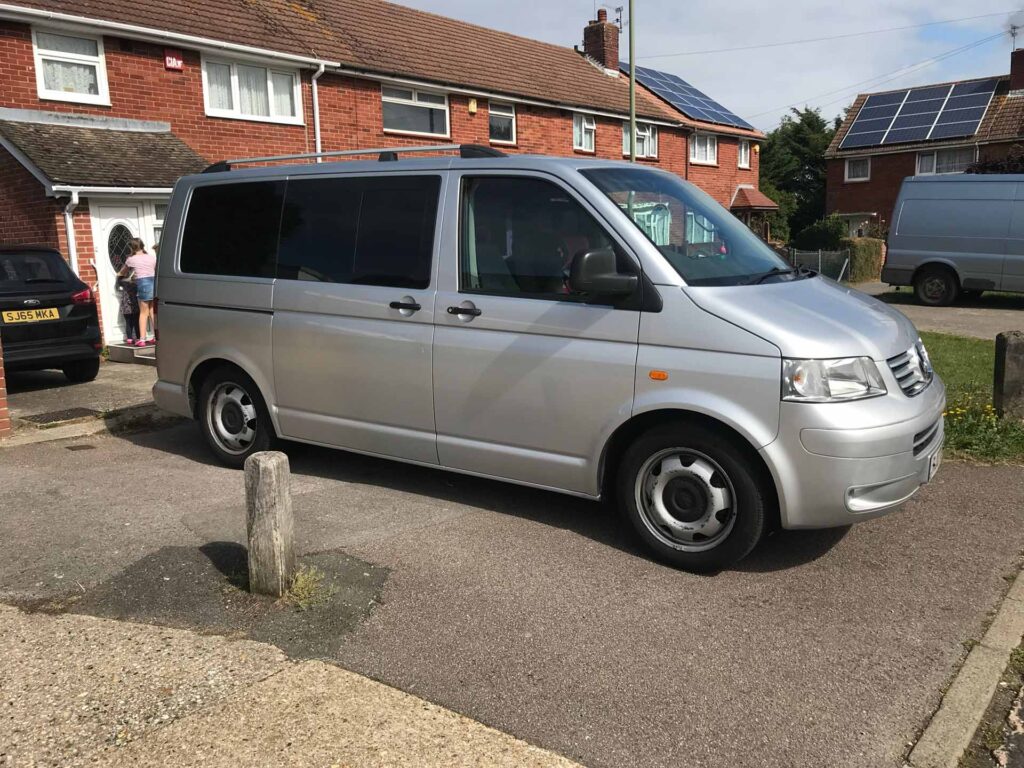
The T5 nevertheless remains an incredibly strong camper platform.
It drives much more like a modern vehicle than a T4, there is enormous conversion support and the combination of purchase price, space and usability explains why so many still sit at the centre of the UK VW scene.
For many people it remains the best compromise in this comparison.
Just don’t mistake compromise for simplicity.
At the opposite end sits the T6.
Volkswagen launched the T6 in 2015, bringing new engines, driver-assistance technology and infotainment improvements. The T6.1 followed in 2019 with a redesigned dashboard, new steering system and significantly increased connectivity and electronic integration. Volkswagen Vans
This is where Frankie’s T6 adds another side to the argument.
A T6 represents a much larger initial financial commitment.
But sometimes spending more at the beginning makes perfect sense.
You’re potentially removing another decade or two of corrosion, seized hardware, deteriorated rubber components, previous-owner modifications and accumulated repairs from the equation.
That doesn’t mean a T6 is risk-free.
It means you’re buying less age.
Modern diesel systems bring their own considerations. DPFs, EGR systems and, where applicable, SCR/AdBlue systems introduce components that simply don’t exist on older vans. Automatic DSG-equipped Transporters require proper maintenance too; Volkswagen currently states that applicable DSG gearbox oil should be changed every 40,000 miles, with the filter changed where required. Volkswagen Vans
For someone commuting in the van during the week, taking the family away at weekends and having no desire to spend Sunday underneath it, paying substantially more for a well-maintained T6 may therefore be entirely rational.
The T6 isn’t necessarily less risky.
It may carry less age-related risk.
That’s different.

This is where we think first-time buyers get caught.
You save £12,000.
You look for £12,000 campers.
Then you spend £12,000.
Nothing remains for tyres, brakes, servicing, cambelts where applicable, insurance, security, electrical faults, a leisure battery or whatever the van decides to introduce you to during month two.
That is not really a £12,000 camper budget.
Never spend your whole camper budget buying the camper.
A cheaper van with a sensible reserve can be considerably more enjoyable than owning the most expensive vehicle you could just about afford.
And Volkswagen-specific costs can surprise people.
The aftermarket is enormous, so plenty of service and conversion parts are inexpensive. But some genuine, OE-quality or engine-specific components combined with specialist labour can quickly turn what looked like a manageable repair into a much bigger bill.
Jobs also have a habit of growing.
You dismantle something to repair one fault and find another worn component behind it.
Anyone who has owned older vehicles will recognise the pattern.
That doesn’t mean you shouldn’t buy one.
It means contingency money is part of the purchase price.
There is another important mistake first-time buyers make.
They inspect the kitchen.
They admire the rock-and-roll bed.
They play with the LED lighting.
Then they buy it.
Instead, mentally separate the vehicle into two purchases:
1. The Volkswagen Transporter.
2. The camper conversion fitted to it.
Inspect them independently.
A gorgeous camper interior can hide a poor base van.
An immaculate T5 underneath can also contain a badly installed conversion.
Rear travelling seats deserve particularly serious consideration. UK government guidance says passengers are safest in properly installed forward- or rear-facing seats with suitable restraints, and seatbelt anchorages need to withstand substantial impact forces. Professional installation is strongly recommended. Side-facing seats are specifically discouraged for passenger travel, particularly where child restraints are involved. GOV.UK
A rock-and-roll bed being comfortable at a campsite does not tell you whether it is suitable for carrying your children down the motorway.
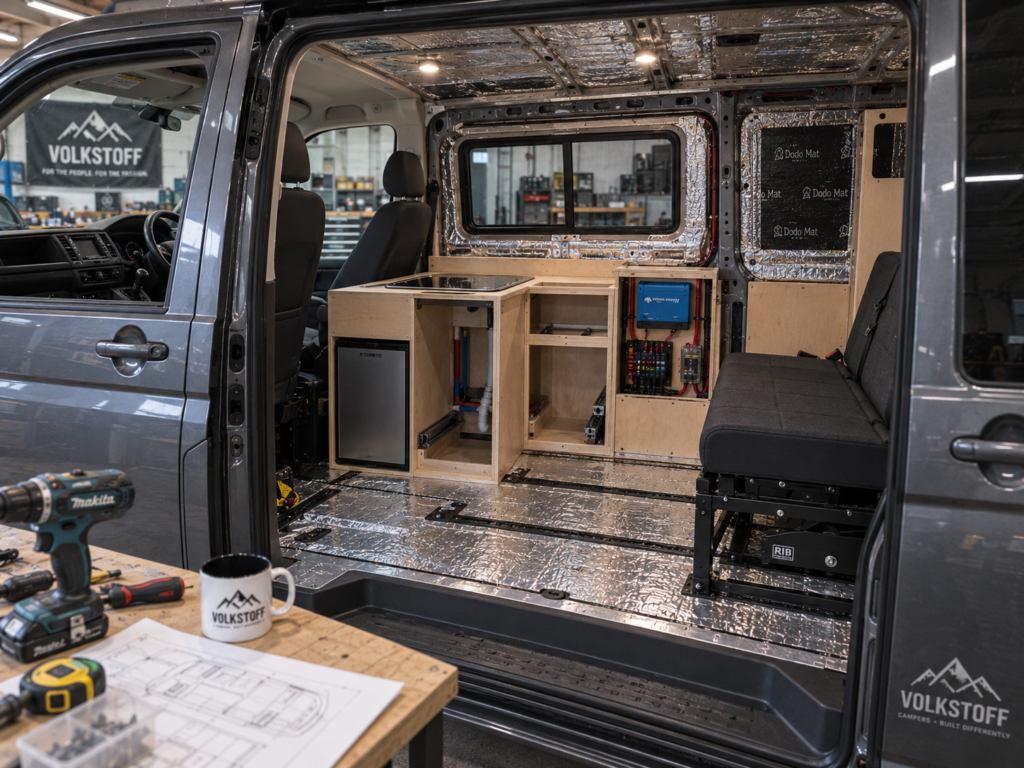
Conversions also need sensible electrical installation, ventilation and consideration of payload.
Batteries, water, passengers, furniture, awnings and camping equipment all add weight.
DVLA also makes clear that simply fitting camper equipment does not automatically guarantee the body type will be changed to “motor caravan”. The vehicle has to meet specified requirements, including recognisable external characteristics, although a vehicle can still be used as a camper even where the recorded body type is not changed. GOV.UK
For first-time buyers, paying for an independent mechanical inspection — and specialist conversion advice where necessary — can be money extremely well spent.
This is one area where there genuinely isn’t a best answer.
Short-wheelbase Transporters are easier to manoeuvre, easier to park and make excellent everyday vehicles.
Long-wheelbase vans give you something almost impossible to add afterwards:
more room.
For couples travelling lightly, an SWB conversion can be brilliant.
Start adding children, dogs, bikes, clothing, food, camping equipment and several wet British weekends and that extra LWB space starts making considerably more sense.
The same applies to panel vans, Kombis and Shuttles.
A panel van gives a converter a blank canvas.
A Kombi already provides windows and rear passenger accommodation.
A Shuttle may start life with a more passenger-orientated interior but may involve substantially more stripping when the goal is a traditional camper layout.
Don’t buy the configuration somebody on Instagram says is best.
Buy the one that suits how you will actually travel.
If you’re mechanically minded, enjoy working on older vehicles and want character above refinement, the T4 still makes a compelling camper.
But buy on structure and condition before paintwork, wheels or interior.
If you want the strongest overall balance between purchase price, driving experience, conversion support and enthusiast knowledge, the T5/T5.1 probably remains the sweet spot for the widest number of people.
But learn the engine and drivetrain you’re buying.
If your camper also needs to function as dependable everyday family transport and your budget allows it, the T6/T6.1 makes a very convincing argument.
You’re paying substantially more to start with, but potentially removing years of age-related deterioration from the equation.
There is no free option.
T4 ownership can ask for time and mechanical involvement.
T5 ownership can ask you to understand increasingly complicated mechanical and electronic systems.
T6 ownership asks for considerably more money at the beginning and may produce expensive modern-system repairs later.
Which brings us back to the question behind this entire comparison:
How much are you prepared to spend to enjoy yourself?
Because eventually the spreadsheet stops telling the whole story.
Something breaks.
You fix it.
Another job appears while you’re fixing that.
You question why you ever bought an old van.
Then Friday arrives.
The chairs get thrown in the back. The fridge gets filled. The kids climb aboard. The destination might be a VW show, a campsite, a beach or somewhere you’ve never bothered visiting before.
And the argument changes.
These vans provide a kind of freedom that is difficult to assign a price to.
That doesn’t justify buying a bad one.
It doesn’t mean breakdowns are somehow romantic.
And loving Volkswagen culture doesn’t mean ignoring repair bills.
It simply means affordability needs to include what the vehicle gives you as well as what it takes from you.
Steve’s T4, our experiences with the T5 and the little BNZ brotherhood and sisterhood that develops around them, and Frankie’s T6 all represent different points on that same journey.
So which wins VW T4 vs T5 vs T6?
Our answer is deliberately less exciting than picking a badge:
Buy the best-maintained Transporter, with the best-quality conversion, that leaves enough money in your budget to look after it.
Not automatically the cheapest.
Not automatically the newest.
And definitely not automatically the one with the nicest wheels.
For the People. For the Passion.