There are faster Volkswagens. Rarer Volkswagens. More valuable Volkswagens. But few individual cars have become as instantly recognisable as the Herbie Volkswagen Beetle.
You don’t even need the whole car.
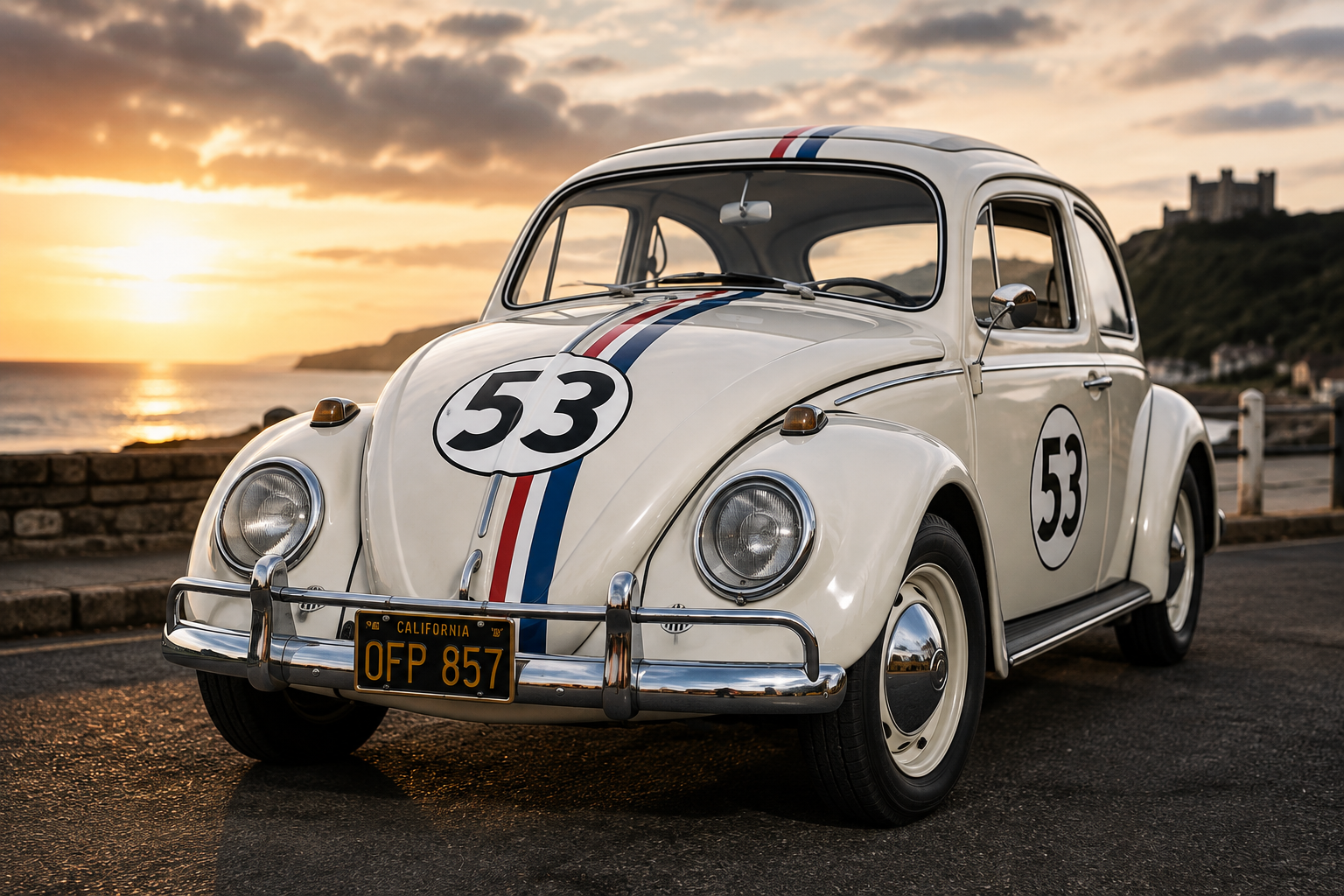
A white bonnet. Red, white and blue stripes. A black 53 inside a circle.
That’s enough.
People don’t simply recognise it as an old Volkswagen Beetle. They know it’s Herbie.
More than half a century after The Love Bug, that is quite an achievement for a small, rear-engined people’s car that was never designed to be a racing machine, never intended to become a film star and certainly wasn’t built to embarrass sports cars.
Yet Herbie’s success makes more sense when you look closely at the Volkswagen chosen for the role.
The Beetle already had personality. Disney simply gave that personality a name, a number and a racing stripe.
And in doing so, it created perhaps the most famous individual Volkswagen in history.
Before Herbie wore 53, the Volkswagen Beetle had already become one of the strangest success stories in motoring.
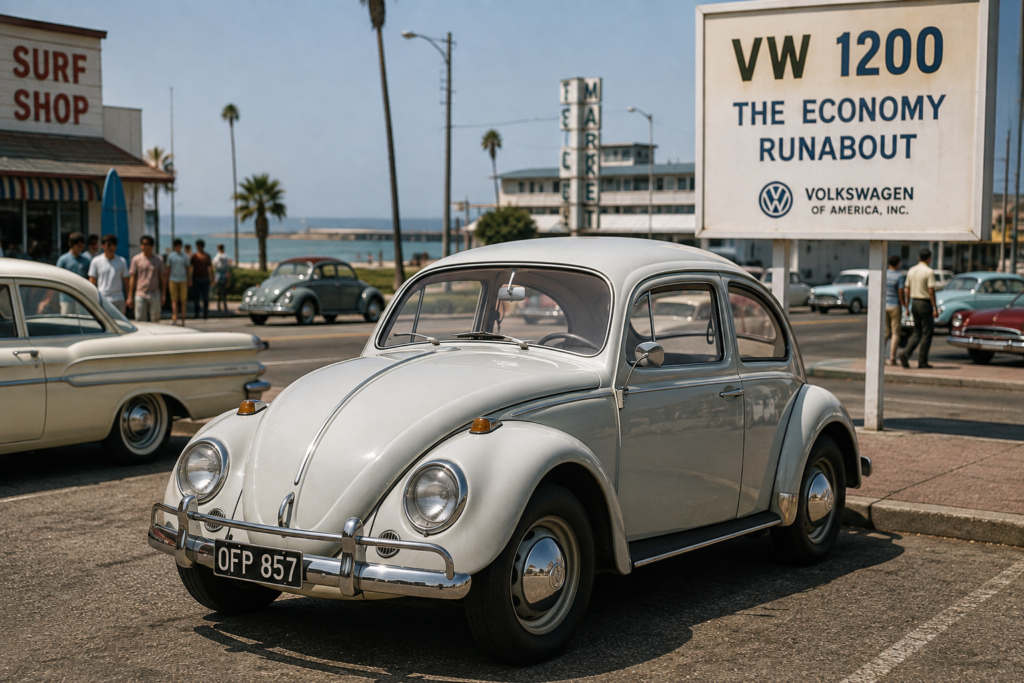
By the 1960s it stood apart from almost everything surrounding it on American roads.
American manufacturers were producing cars with long bonnets, acres of chrome, large engines and styling that could change dramatically from one model year to another.
The Beetle did things differently.
It was small. Rounded. Mechanically unconventional. Its air-cooled flat-four sat behind the rear wheels and produced a sound immediately familiar to anyone who has spent time around an air-cooled VW.
Its shape barely seemed interested in fashion.
And that became part of its appeal.
Volkswagen’s American advertising famously embraced the car’s differences rather than disguising them. Campaigns such as Think Small used understatement and humour at a time when much of the car industry was selling size, power and excess.
The little Volkswagen increasingly represented something different.
It was affordable transport, but it also appealed to people who weren’t particularly interested in following the conventional American idea of what a car should be.
More importantly for what happened next, the Beetle was unusually easy to imagine as a character.
Look at one from the front.
Those round headlights could be eyes. The bonnet forms something resembling a nose. The separate wings give the body shoulders. Even the little air-cooled engine has a distinctive mechanical voice.
Owners have been giving Beetles names for decades.
Disney was about to take that idea much further.
The roots of The Love Bug can be traced to a story called Car, Boy, Girl by Gordon Buford.
It is sometimes described online as a published novel, but the surviving evidence isn’t that straightforward. Disney records the film as being based on Buford’s story, while historical catalogue records credit Buford alongside screenwriters Bill Walsh and Don DaGradi.
The available evidence suggests Car, Boy, Girl was an unpublished story acquired and developed by Disney rather than a widely released novel.
Its central idea was simple: a car possessing a personality and will of its own.
But that car didn’t necessarily have to be a Volkswagen.
One of the best-known stories about the development of The Love Bug concerns producer Bill Walsh arranging several small cars outside Disney’s studio commissary to see how people reacted to them.
Various accounts have subsequently produced lists of alternative cars supposedly considered for the role, including models from Toyota, Volvo, MG and TVR.
Those lists should be treated with some caution because versions of the story differ.
What Disney’s own historical account does support is much simpler.
People responded differently to the Volkswagen.
They didn’t merely inspect it.
They touched it. They patted it.
The Beetle already encouraged people to treat it almost like a living thing.
Disney had found its car.
The transformation wasn’t particularly complicated.
A pearl-white Volkswagen Beetle received red, white and blue racing stripes running over its body, large racing roundels and the number 53.
That was essentially it.
No wild bodykit. No huge graphics package. No complicated character face added to the bodywork.
The shape of the Beetle did most of the work.
The result was one of the simplest and most effective pieces of movie-car design ever created.
And the number became particularly important.
The origin of Herbie 53 has generated plenty of folklore, but the most consistently documented explanation connects the number to producer Bill Walsh.
Walsh was a baseball fan, and 53 is generally attributed to Los Angeles Dodgers pitcher Don Drysdale, who wore the number during his career.
Drysdale became one of the Dodgers’ most celebrated players and his number 53 was subsequently retired by the team.
The racing stripes are less straightforward.
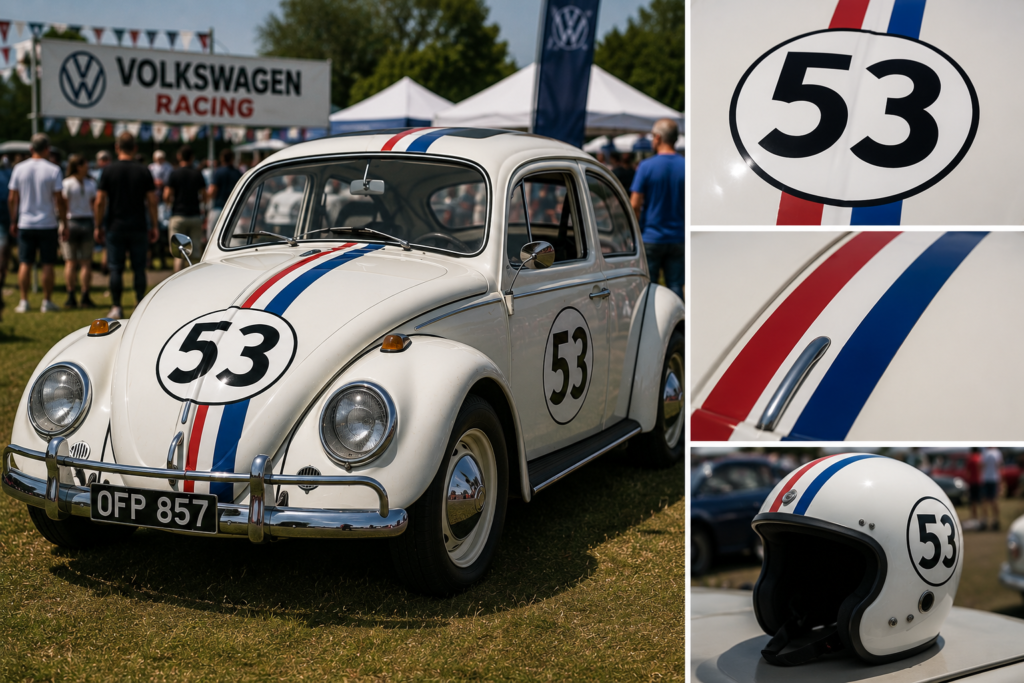
Herbie’s red, white and blue treatment is frequently given elaborate meanings online, but firm evidence supporting many of those explanations is difficult to find.
What can be said confidently is that the stripes gave the white Beetle a convincing competition identity while creating a design that could be recognised almost immediately.
White body.
Red, white and blue.
53.
The combination would eventually become inseparable from the car.
This is where Herbie history gets complicated.
Ask where the original Herbie is today and there isn’t a simple answer.
Herbie was never one Volkswagen Beetle that performed every scene.
Film productions require different cars for different jobs, and multiple Beetles were prepared for The Love Bug and its successors.
Some needed to look immaculate.
Others had to race.
Some were required for stunt sequences.
Others were modified so Herbie could apparently drive himself.
Certain cars were built to perform very specific tricks and could be considerably different underneath from the standard Beetle they appeared to be.
That means the phrase “original Herbie” needs qualification whenever a surviving car is discussed.
There are genuine screen-used Herbies.
There isn’t one Beetle that did everything.
Some of the engineering behind the Herbie movie car fleet was surprisingly serious.
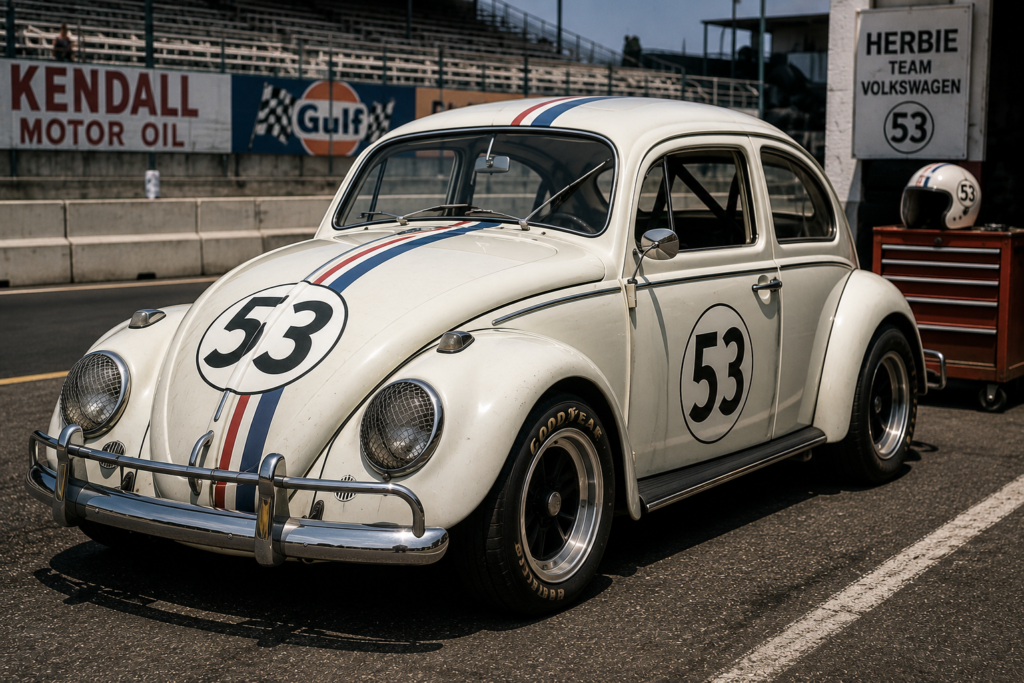
One particularly interesting survivor is the car commonly known as H2, now in Britain and associated with Terry’s Beetle Services.
Its documented history links it to the original production and California Volkswagen tuning firm EMPI.
H2 was prepared as one of the quicker competition cars rather than simply being a standard Beetle wearing movie graphics.
The surviving car has been described as incorporating sections from different Beetles and receiving substantial mechanical modifications, including Porsche-derived power, uprated suspension components, Koni dampers and Porsche braking hardware.
That’s important because the Herbie seen on screen often needed to do things a stock early-1960s Beetle simply wasn’t capable of doing convincingly.
But outright speed was only one challenge.
The filmmakers also had to make the car appear to drive itself.
That required some clever mechanical trickery.
Different Herbies were adapted with concealed driving arrangements that allowed stunt drivers to operate the car while remaining hidden from the camera.
Depending on the production and particular car, this could involve alternative steering controls, extended pedals and a driver positioned unusually low or away from the conventional driving position.
Later filming techniques made the illusion increasingly sophisticated.
Then there were the stunt cars.
These weren’t precious museum pieces during production. They were working vehicles expected to take knocks, perform jumps and repeat scenes until the filmmakers had what they needed.
Some surviving screen cars still carry evidence of that treatment.
The central joke behind Herbie only works because the Volkswagen Beetle is such an unlikely racing hero.
A Beetle was designed to provide practical and relatively affordable transport.
It wasn’t supposed to dominate races.
Put an exotic sports car in Herbie’s place and much of the appeal disappears.
Of course a sports car should be quick.
A little Volkswagen Beetle humiliating machinery that should leave it behind is much more entertaining.
And this is where the story starts feeling particularly familiar to Volkswagen enthusiasts.
Because VW owners have spent decades doing something remarkably similar.
Take the ordinary car and make it personal.
Lower it.
Tune it.
Put a bigger engine in it.
Change the wheels.
Improve the suspension.
Strip weight out.
Build something in a garage that performs far beyond what anybody expects from the badge on the bonnet.
Air-cooled drag Beetles have been doing it for generations.
Later, Golfs became famous for it.
Then Polos, Corrados, Caddys and Transporters joined in.
A standard-looking Volkswagen unexpectedly disappearing up the road is almost a VW-scene tradition.
Herbie turned that same underdog appeal into family entertainment.
The Love Bug was produced in 1968 and received its US theatrical release in March 1969.
Its success transformed Herbie from a one-film character into something Disney could return to repeatedly.
The film established the basic formula without needing to explain too much.
Herbie was temperamental, competitive, loyal and capable of making his own decisions.
Most importantly, the filmmakers largely allowed the Beetle itself to provide the expression.
That restraint matters.
Herbie didn’t need cartoon eyes attached to the windscreen.
The Beetle already had a face.
Herbie Rides Again followed in 1974 and pushed the character beyond the original racing story.
Then came Herbie Goes to Monte Carlo in 1977, returning the Volkswagen to competition and placing the tiny Beetle against a European racing backdrop.
Herbie Goes Bananas arrived in 1980.
By this point, something interesting had happened.
Herbie no longer needed an introduction.
Show audiences the stripes and 53 and they understood the character.
A television series followed in 1982 before a television film in 1997 brought Herbie back again, including the return of Dean Jones as Jim Douglas.
Then the little Volkswagen went quiet.
For a while.
By 2005, automotive culture looked very different from the world in which Herbie had originally appeared.
The modified-car boom was in full swing.
Newsagents were packed with tuning magazines. Bodykits, large wheels, spoilers, ICE installs and increasingly extreme styling had entered mainstream youth car culture.
The Fast and the Furious had arrived in 2001 and helped push modified cars into popular entertainment on a huge scale.
Disney couldn’t simply pretend none of that had happened.
So Herbie: Fully Loaded, starring Lindsay Lohan, brought the Beetle into a very different automotive world.
Herbie received a much more aggressive interpretation during parts of the film, with wider wheels, lowered suspension, spoilers and styling influenced by contemporary modified-car culture.
Eventually, the story even took the Beetle into NASCAR.
It was Herbie for the Max Power generation.
And while some air-cooled purists might prefer the simpler appearance of the original car, Fully Loaded achieved something important.
It introduced Herbie to children who hadn’t grown up watching the earlier films.
The styling changed.
The fundamental identity didn’t.
White Beetle.
Stripes.
Nearly four decades after the original production, that was still enough.
Because multiple Beetles were used across several productions, surviving Herbie cars need to be discussed carefully.
Some have strong documented screen histories.
Others have been promotional cars.
There are also countless replicas, ranging from casual tributes to painstaking recreations.
One documented screen-used Beetle associated with Herbie Goes to Monte Carlo and Herbie Goes Bananas sold at Barrett-Jackson’s Palm Beach auction in 2015 for a reported $126,500 including fees.
The same vehicle later appeared at auction again.
But even with well-documented cars, describing one as “the original Herbie” oversimplifies the history.
A better description is often screen-used Herbie followed by the particular production and, where known, the role that car performed.
That’s the difference between movie-car history and movie-car mythology.
Perhaps the most impressive part of the Herbie Volkswagen Beetle story isn’t found in a Disney archive or an auction catalogue.
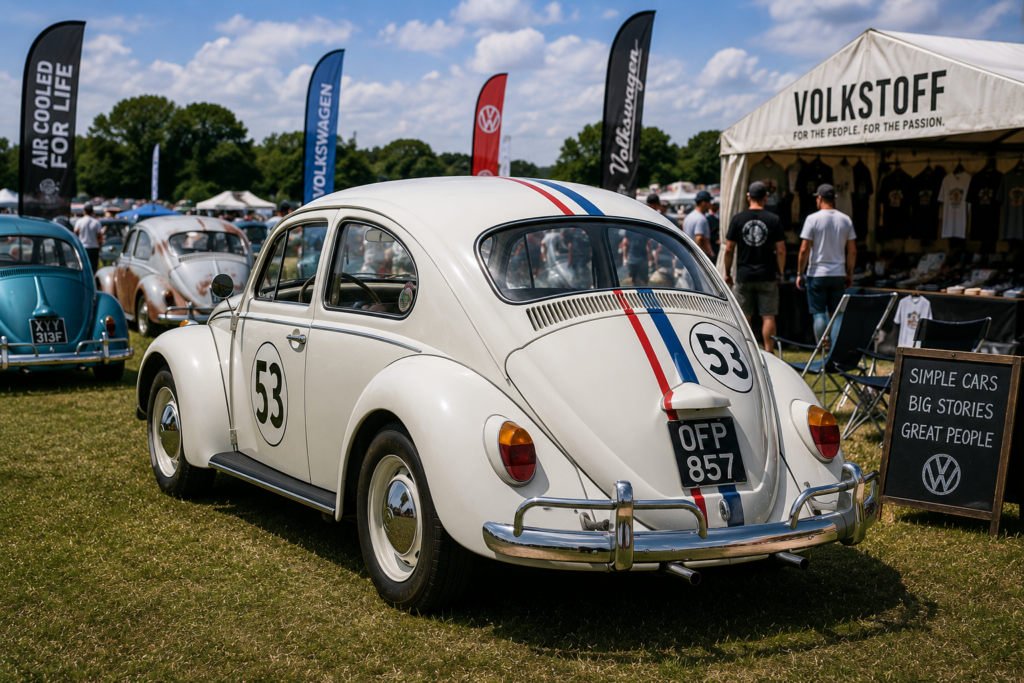
It’s found on VW show fields.
Go to a large air-cooled Volkswagen event and eventually you’ll probably find one.
A white Beetle wearing 53.
Some are extraordinarily detailed recreations. Their owners research the correct wheels, graphics, trim, interior details and differences between the cars appearing in particular films.
Others are much simpler.
An owner has a white Beetle, loves Herbie and adds the stripes and numbers.
Both work.
Because the design has become visual shorthand.
You don’t need the words The Love Bug written across the windscreen.
You don’t need a Disney logo.
You barely need the Volkswagen itself.
Show somebody a 53 inside a black circle alongside red, white and blue stripes, and there’s a good chance they know what you’re referencing.
Few movie cars have achieved that.
It would be ridiculous to suggest Herbie created the Beetle phenomenon.
The Volkswagen Beetle had already achieved enormous international success.
More than 21 million examples of the original air-cooled design would eventually be produced. The Beetle developed communities and cultural identities around the world entirely independently of Disney.
Its place in Volkswagen Beetle history would have been secure without The Love Bug.
But Herbie added another layer.
The films encouraged generations to see the Beetle as a car with personality.
And that idea fitted remarkably well with how many owners already felt about them.
Spend time around old Volkswagens and cars acquire names quickly.
Owners know the noise that means everything is fine and the slightly different noise that means the toolbox is coming out.
They know which door needs a harder push.
They know the hot-start procedure.
They know the rattle they’ve been meaning to fix for three years.
They know exactly how far they can trust the fuel gauge.
Eventually the car’s collection of imperfections becomes its personality.
Herbie simply made that relationship literal.
This is probably why a Herbie VW Beetle still feels completely at home on a Volkswagen show field.
Herbie isn’t intimidating.
You don’t need encyclopaedic knowledge of chassis numbers, decklids, engines or factory paint codes to enjoy the car.
A child can recognise Herbie.
Their parents may remember Fully Loaded.
Their grandparents may remember The Love Bug.
All three generations can walk towards the same Beetle for completely different reasons.
That’s unusual.
The Volkswagen scene can sometimes become obsessed with specifications, originality, rarity and what’s considered the “right” way to build a car.
Herbie cuts through most of that.
He’s simply a Volkswagen people like.
And underneath the Disney story sits an idea that feels completely at home within VW culture.
Take an ordinary car and see something special in it.
If we’re comparing complete Volkswagen models, the argument is impossible to settle.
The Beetle itself is one of the most recognisable cars ever produced.
The VW Bus became a cultural symbol extending far beyond motoring.
The Golf GTI changed people’s expectations of what an everyday hatchback could do.
Transporters have spawned an entire camper and lifestyle scene.
Each has a legitimate claim to Volkswagen fame.
But that’s not quite the question.
We’re talking about one specific Volkswagen identity.
And there aren’t many serious challengers to the Herbie Volkswagen Beetle.
You can show someone a white Beetle with 53 on the bonnet without mentioning Volkswagen, Disney or The Love Bug.
They already know.
More than half a century after Herbie first appeared, replicas still arrive at VW shows. Children still recognise him. Model cars still sell. Owners still spend weekends masking red, white and blue stripes over white Beetle bodywork.
Perhaps that’s because the idea behind Herbie was never actually as fictional as it seemed.
Volkswagen culture has always been full of ordinary cars that became extraordinary because somebody saw something in them.
They get modified.
They get names.
They acquire scratches, stickers, breakdown stories and memories.
Families grow up around them.
Some are sold and regretted.
Some sit in garages waiting for the rebuild their owners have been promising for years.
Some receive far more money than they’re economically worth because their owners couldn’t care less what a spreadsheet says.
Eventually, they’re no longer simply a Beetle, Golf, Bus or Transporter.
They’re your Beetle.
Your Golf.
Your Bus.
That’s the part of Herbie that Volkswagen people understand instinctively.
Herbie may be fictional.
The idea behind him is very real.
For the People. For the Passion.